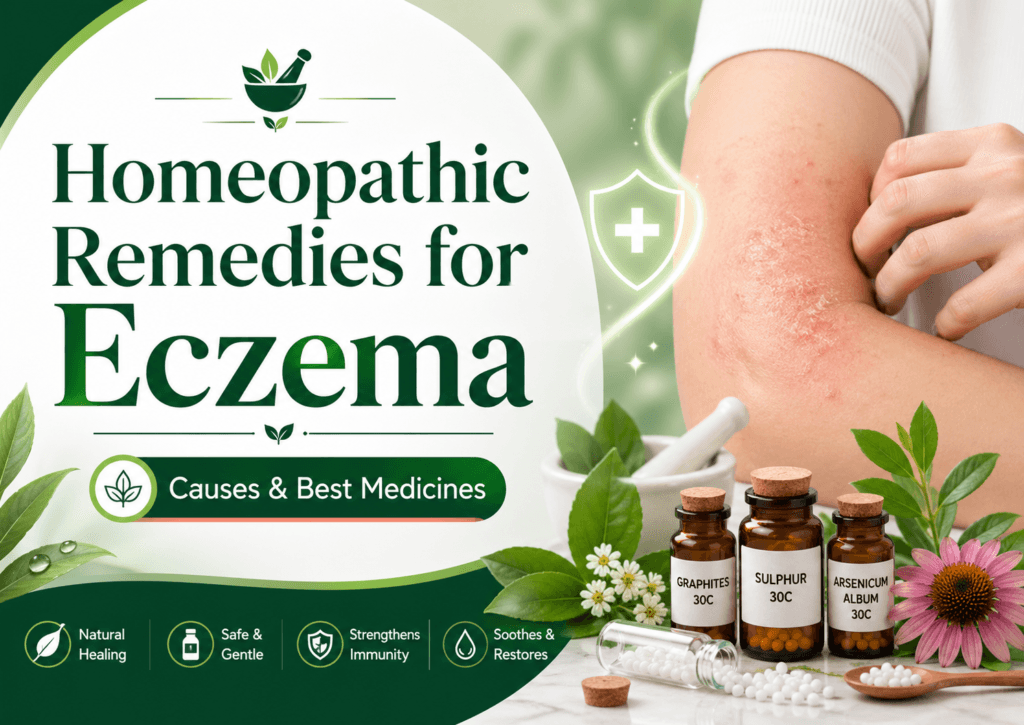
Homeopathic Remedies for Eczema – Causes & Best Medicines


What Is Eczema?
Eczema is a common inflammatory skin condition that causes dryness, itching, redness, irritation, scaling, and sometimes oozing or cracking of the skin. The most common form is atopic dermatitis, but eczema can appear in different patterns such as hand eczema, contact dermatitis, nummular eczema, dyshidrotic eczema, and seborrheic-type irritation.
For many people, eczema is not just a skin problem. It can disturb sleep, affect confidence, cause repeated scratching, and make daily life uncomfortable. Some people experience mild seasonal dryness, while others struggle with recurring flare-ups for years.
Many patients search for homeopathic remedies for eczema because they want a gentle, individualized, and long-term supportive approach. Homeopathy looks at eczema not only by the appearance of the skin, but also by the person’s overall sensitivity, triggers, itching pattern, emotional stress, food reactions, weather sensitivity, and tendency for recurrence.
Homeopathy should be used responsibly. Severe, infected, spreading, painful, or persistent eczema should be evaluated by a qualified healthcare provider. Homeopathic treatment may support skin health and help reduce flare tendency in selected cases, but it should not replace emergency care, dermatology treatment, or prescribed medicines when they are medically needed.
Common Symptoms of Eczema
Eczema symptoms can vary from person to person. Some people have dry, rough patches, while others develop oozing, crusting, or intense burning.
Common symptoms include:
- Dry, rough, or sensitive skin
- Itching that may become worse at night
- Red, inflamed, or darkened skin patches
- Scaling, flaking, or peeling
- Cracks in the skin, especially on hands or feet
- Small blisters or fluid-filled eruptions
- Oozing or crusting in some cases
- Thickened skin due to repeated scratching
- Burning, stinging, or soreness
- Recurring flare-ups after stress, weather change, or allergens
In darker skin tones, eczema may look brown, purple, grayish, or darker than the surrounding skin instead of bright red. Long-standing eczema may also leave post-inflammatory pigmentation.
What Causes Eczema?
Eczema usually develops due to a combination of internal sensitivity and external triggers. The skin barrier becomes weak, allowing moisture to escape and irritants to enter more easily. This can lead to inflammation, itching, and repeated scratching.
Common contributing factors include:
- Family history of eczema, asthma, or allergies
- Dry skin or weak skin barrier
- Weather changes, especially cold and dry weather
- Harsh soaps, detergents, fragrances, and chemicals
- Dust, pollen, pet dander, or mold exposure
- Food sensitivities in some individuals
- Stress and lack of sleep
- Sweating or overheating
- Wool or rough clothing
- Frequent hand washing or sanitizer use
- Skin infections
- Hormonal changes
Eczema often runs in cycles. The skin becomes dry and itchy, scratching damages the barrier, inflammation increases, and the itching becomes worse. Breaking this itch-scratch cycle is one of the most important goals in eczema management.
When Should You See a Doctor for Eczema?
Mild eczema can often be managed with skin care, trigger control, and supportive treatment. However, medical evaluation is important in certain situations.
Consult a qualified healthcare provider if:
- Eczema is spreading quickly
- The skin is painful, swollen, hot, or tender
- There is pus, yellow crusting, or signs of infection
- Fever develops along with skin symptoms
- Eczema affects the eyes, eyelids, or face severely
- Itching is disturbing sleep regularly
- The skin cracks and bleeds repeatedly
- Over-the-counter care is not helping
- A child has severe eczema or poor feeding/sleep due to itching
- You are pregnant, immunocompromised, or have another chronic illness
Eczema around the eyes or eyelids needs extra care because the skin is very thin and sensitive. Do not apply strong creams, essential oils, or medicated ointments near the eyes without professional guidance.
Homeopathic View of Eczema
In homeopathy, eczema is treated as a sign of deeper individual sensitivity rather than only a surface-level rash. Two people may have eczema, but their remedy selection may be completely different.
A homeopathic doctor may consider:
- Location of eczema: face, eyelids, hands, folds, scalp, legs
- Type of eruption: dry, wet, cracked, crusted, blistered, thickened
- Itching pattern: worse at night, warmth, bathing, sweating, cold air
- Discharge: watery, sticky, yellowish, crusty, offensive
- Skin sensation: burning, soreness, rawness, crawling, stinging
- Weather sensitivity: winter aggravation, summer aggravation, humidity
- Food cravings and digestion
- Stress, anxiety, irritability, or emotional triggers
- Past use of topical steroid creams or repeated suppressive treatments
- Family history of allergies, asthma, or autoimmune tendencies
The goal of eczema treatment with homeopathic remedies is to support the person’s overall tendency toward balance, reduce recurrence tendency, and help the skin heal more naturally. Remedy selection, potency, and repetition should be individualized and guided by a qualified homeopathic doctor.
Best Homeopathic Remedies for Eczema
Below are commonly used homeopathic medicines for eczema. These are not prescriptions. The correct remedy depends on the complete symptom picture.
1. Graphites
Graphites is one of the most frequently considered homeopathic remedies for eczema, especially when the skin is thick, rough, cracked, and oozing.
It may be considered when:
- Eczema has sticky, honey-like discharge
- Skin becomes cracked behind ears, around mouth, hands, or folds
- The affected area becomes thick, rough, or leathery
- Itching is worse from warmth or at night
- Scratching may lead to bleeding or crusting
- The person may have a tendency toward sluggish digestion or constipation
Graphites is often discussed for chronic eczema where the skin is dry in some areas but moist and sticky in others. It may be especially relevant when eczema appears in skin folds, behind the ears, on the face, or on the hands.
2. Sulphur
Sulphur is traditionally used in eczema with intense itching, burning, redness, and heat.
It may be considered when:
- Itching is worse from warmth, bathing, or being in bed
- Skin feels hot, burning, and irritated
- Scratching gives temporary relief but worsens the skin later
- Eczema looks red, dry, scaly, or inflamed
- Symptoms may worsen after using too many creams or ointments
- The person may feel warm-blooded and dislike heat
Sulphur is often considered in long-standing eczema cases where itching is intense and the skin has a tendency to flare repeatedly. It should be used carefully because unnecessary repetition may aggravate symptoms in sensitive individuals.
3. Arsenicum Album
Arsenicum album may suit eczema with burning, dryness, restlessness, and anxiety.
It may be considered when:
- Skin is dry, scaly, and burning
- Burning improves with warmth
- Itching may be worse at night
- The person feels chilly and restless
- There may be anxiety about health
- Skin may look rough, cracked, or irritated
This remedy is often thought of when eczema is associated with a strong burning sensation and general sensitivity. It may also be considered when the person is very particular, anxious, or easily exhausted.
4. Rhus Toxicodendron
Rhus tox may be considered when eczema has blister-like eruptions, redness, swelling, and intense itching.
It may be useful when:
- Eczema has small vesicles or blisters
- Itching and burning are intense
- Warm applications may give relief
- Skin feels worse in cold, damp weather
- The person feels restless due to discomfort
- There may be stiffness or body aches along with skin complaints
Rhus tox is often discussed in eczema that resembles allergic eruptions or vesicular eczema, especially when the skin feels better from warmth.
5. Petroleum
Petroleum is commonly considered for very dry, cracked eczema, especially in winter.
It may be suitable when:
- Skin is extremely dry, rough, and cracked
- Cracks may bleed, especially on hands, fingertips, palms, or feet
- Symptoms worsen in cold weather
- Skin feels sore, raw, or painful
- Itching may be worse at night or from warmth of bed
- The person may have deep fissures that are slow to heal
Petroleum is often used in homeopathic practice for winter eczema, hand eczema, and eczema with painful cracks.
6. Mezereum
Mezereum may be considered when eczema forms thick crusts with oozing underneath.
It may be useful when:
- Eruptions are very itchy
- Thick scabs or crusts form on the skin
- There may be sticky discharge under the crust
- Scratching worsens the eruption
- Symptoms may affect the scalp, face, or other sensitive areas
- Cold applications may relieve itching in some cases
Mezereum is traditionally used when eczema has a crusted, moist, irritated character.
7. Hepar Sulphuris Calcareum
Hepar sulph may be considered when eczema becomes very sensitive, sore, and prone to infection.
It may suit cases where:
- Skin is extremely tender to touch
- Cracks or eruptions are painful
- There is a tendency for pus formation or infection
- The person feels chilly and sensitive to cold air
- Eczema heals slowly
- The person becomes irritable due to discomfort
If eczema shows signs of infection, medical care is important. Homeopathy may be used as supportive care, but infected eczema should not be ignored.
🌿 Get Expert Homeopathic Care
Consult our experienced homeopathic doctors for personalised treatment
8. Calcarea Carbonica
Calcarea carb may be considered in children or adults with chronic eczema and a constitutional pattern of sensitivity.
It may be useful when:
- Eczema is worse in cold or damp weather
- The person tends to sweat, especially on the head
- Skin may be dry, cracked, or easily inflamed
- There may be fatigue or slow recovery
- The person may feel chilly
- Children may have eczema with digestive sensitivity or delayed milestones
This remedy is usually selected constitutionally, meaning it depends on the person’s full physical and mental pattern, not just the skin rash.
9. Calendula
Calendula is commonly known for its soothing skin-supportive use. In homeopathy and herbal skin care, it is often associated with irritated, raw, or minor injured skin.
It may support:
- Minor skin irritation
- Rawness from scratching
- Skin healing support
- Mild inflammation
- Cracked or sensitive areas
Calendula may be found in some topical preparations. However, even natural products can irritate eczema-prone skin. Always patch test and avoid using any product on open, infected, or severely inflamed skin without professional advice.
10. Natrum Muriaticum
Natrum mur may be considered when eczema is linked with emotional stress, grief, sun sensitivity, or dryness.
It may suit cases where:
- Eczema appears around hairline, face, or folds
- Skin is dry, cracked, or irritated
- Symptoms worsen from sun exposure in some cases
- The person may be emotionally reserved
- Stress or suppressed emotions may trigger flare-ups
This is usually a constitutional remedy and should be selected after detailed case-taking.
Homeopathic Medicine for Eczema: How Is the Right Remedy Selected?
Many people search for “homeopathic medicine for eczema” expecting one best medicine. In reality, homeopathy works best when the medicine matches the individual case.
For example:
- Dry, cracked winter eczema may need one remedy.
- Oozing eczema behind the ears may need another.
- Burning eczema worse from warmth may need another.
- Eyelid eczema after cosmetic sensitivity may need a different approach.
- Eczema in a child with food sensitivity may require constitutional treatment.
A homeopathic doctor usually studies the full case before selecting a remedy. This includes skin symptoms, general health, digestion, sleep, sweating, allergies, stress, family history, and past treatments.
Eczema Treatment: Homeopathic Remedies and Practical Skin Care Together
Eczema treatment with homeopathic remedies works best when combined with good skin care and trigger management. Even the best-selected remedy may not work well if the skin barrier is constantly irritated.
Helpful skin care steps include:
- Use fragrance-free, gentle cleansers
- Avoid hot showers and long baths
- Apply moisturizer immediately after bathing
- Choose thick, bland moisturizers for very dry skin
- Wear soft cotton clothing
- Avoid wool or rough fabrics
- Keep nails short to reduce scratching damage
- Use cool compresses during intense itching
- Identify triggers such as detergents, foods, sweating, or stress
- Avoid strong perfumes, harsh soaps, and alcohol-based products
For many people, eczema improves when the skin barrier is protected consistently. Homeopathy may support the internal tendency, while daily skin care reduces external irritation.
Homeopathic Cream for Eczema
Many people search for a homeopathic cream for eczema because they want relief from itching, dryness, redness, or irritation. A topical cream may help soothe the surface symptoms, but eczema often needs deeper individualized care when it is chronic or recurrent.
A homeopathic cream may include ingredients traditionally used for skin irritation, such as calendula or other soothing components. These creams may support mild dryness, itching, or irritated patches. However, not every “natural” cream is safe for every person with eczema.
Important precautions:
- Always patch test a new cream on a small area first.
- Avoid creams with fragrance, harsh preservatives, or strong essential oils.
- Do not apply any cream into the eyes.
- Avoid self-treating infected, bleeding, or severely inflamed skin.
- Stop using the cream if burning, redness, or itching worsens.
- For babies, pregnant women, or people with severe eczema, seek professional advice first.
A cream may provide temporary local comfort, but chronic eczema usually needs a complete treatment plan that includes skin care, trigger control, diet review if needed, stress management, and individualized homeopathic treatment.
Homeopathic Remedies for Eczema on Face
Eczema on the face can be emotionally distressing because it is visible and sensitive. Facial skin is thinner than skin on many other parts of the body, so harsh products can worsen irritation.
Common triggers for facial eczema include:
- Cosmetics or makeup
- Sunscreen sensitivity
- Fragranced skin products
- Face wash or exfoliants
- Shaving products
- Weather changes
- Sweat
- Mask friction
- Food or environmental allergies in sensitive people
Homeopathic remedies for eczema on face are selected based on the appearance and triggers. For example, Graphites may be considered when there are cracks and sticky oozing around the mouth or behind the ears. Sulphur may be considered when facial eczema is red, hot, itchy, and worse from warmth. Arsenicum album may be considered when dryness and burning are prominent.
Facial eczema should be handled gently. Avoid scrubbing, exfoliating, bleaching creams, steroid misuse, and frequent product changes. A simple routine with gentle cleansing and fragrance-free moisturizing is often better than using many products.
Homeopathic Remedies for Eczema on Eyelids
Eczema on eyelids needs special caution. The eyelid skin is extremely thin and easily irritated. It can react to cosmetics, eye drops, nail polish, hair dye, face creams, fragrances, pollen, dust, and contact lens solutions.
Symptoms may include:
- Dry, flaky eyelids
- Redness or darkening around the eyes
- Itching or burning
- Swelling
- Cracking at the eyelid folds
- Watery eyes due to irritation
Homeopathic remedies for eczema on eyelids should be selected carefully. Graphites may be considered if there is cracking and oozing around eyelid folds or behind the ears. Arsenicum album may be considered if burning and dryness are prominent. Sulphur may be considered if itching is intense and worse from warmth.
Do not apply random creams, essential oils, or strong ointments on eyelids. If there is eye pain, vision change, severe swelling, discharge from the eye, or symptoms only around one eye, consult a healthcare professional promptly.
Eczema in Children and Homeopathic Support
Eczema is common in children and may appear on cheeks, scalp, folds of elbows, behind knees, wrists, ankles, or trunk. Children may scratch until the skin bleeds, especially at night.
In children, treatment should be gentle and supervised. Parents should avoid repeated self-medication or frequent changes in creams and remedies.
Helpful steps include:
- Use mild, fragrance-free bathing products
- Keep bath water lukewarm
- Moisturize frequently
- Use soft cotton clothing
- Keep nails trimmed
- Avoid overheating
- Track food or environmental triggers if flare-ups are repeated
- Consult a doctor if sleep, feeding, or growth is affected
Homeopathic treatment in children is usually constitutional. Remedies such as Calcarea carb, Graphites, Sulphur, Mezereum, or others may be considered depending on the total case.
Diet and Lifestyle Tips for Eczema
Diet does not cause eczema in every person, but some individuals may notice flare-ups after certain foods. Avoid extreme diets unless advised by a qualified professional.
General supportive tips include:
- Drink enough water
- Eat a balanced diet with vegetables, fruits, protein, and healthy fats
- Avoid known personal food triggers
- Reduce excess sugar and processed foods if they worsen inflammation
- Support gut health with a balanced diet
- Manage stress through breathing, walking, meditation, or sleep routine
- Keep the bedroom cool if itching worsens at night
- Use a humidifier in dry weather if needed
- Wash new clothes before wearing
- Use fragrance-free laundry detergent
Stress does not mean eczema is “only psychological.” Stress can worsen inflammation and itching, but eczema is a real skin condition that needs proper care.
Potency and Dosage Caution in Homeopathy
Homeopathic remedies are available in different potencies such as 6C, 30C, 200C, 1M, and others. Higher potency does not always mean better treatment. The right potency depends on the intensity of symptoms, chronicity, sensitivity of the patient, age, vitality, and overall case picture.
General safety points:
- Do not repeat remedies frequently without guidance.
- Avoid taking multiple remedies together unless advised.
- Stop and consult a doctor if symptoms worsen significantly.
- Do not discontinue prescribed eczema medication suddenly.
- Children, pregnant women, elderly people, and people with chronic illness should take professional guidance.
- In chronic eczema, constitutional treatment is usually better than random remedy selection.
Self-treatment may be reasonable only for mild, short-term irritation. Chronic, recurrent, severe, infected, or facial/eyelid eczema should be managed with professional help.
What Makes Homeopathy Different in Eczema Care?
Conventional eczema care often focuses on moisturizing, avoiding triggers, reducing inflammation, and controlling itching. These steps are important and should not be ignored.
Homeopathy adds an individualized approach. Instead of giving the same remedy to every eczema patient, it looks at the unique pattern of the person.
For example:
- One person has dry, cracked eczema worse in winter.
- Another has oozing eczema behind the ears.
- Another has burning eczema worse from warmth.
- Another has eyelid eczema triggered by cosmetics.
- Another has childhood eczema with digestive sensitivity.
- Another has flare-ups after stress or grief.
Each of these cases may need a different remedy. This is why homeopathic eczema treatment is most effective when it is personalized.
Can Homeopathy Cure Eczema Permanently?
It is better not to think of eczema in terms of guaranteed cure. Eczema is often a chronic tendency influenced by genetics, immunity, skin barrier health, environment, stress, and triggers.
Homeopathy may help some people reduce the frequency, intensity, and recurrence of flare-ups when the remedy is well selected and the overall plan is followed. However, results vary from person to person.
A responsible treatment goal is:
- Reduce itching
- Improve skin comfort
- Support healing of dry or cracked patches
- Reduce repeated flare-ups
- Improve sleep and quality of life
- Identify triggers
- Avoid unnecessary skin irritation
- Support long-term skin resilience
Any treatment that promises a guaranteed permanent cure for eczema should be viewed with caution.
Daily Eczema Care Routine to Support Healing
A simple daily routine can make a big difference.
Morning
- Wash with lukewarm water or a gentle cleanser.
- Avoid scrubbing.
- Apply moisturizer while skin is slightly damp.
- Use soft, breathable clothing.
- Avoid fragrance-based products.
During the Day
- Avoid scratching as much as possible.
- Use cool compresses for intense itching.
- Reapply moisturizer on dry patches.
- Avoid overheating and sweating when possible.
- Keep hands protected if using detergents or chemicals.
Night
- Take a short lukewarm bath if helpful.
- Apply moisturizer generously.
- Keep nails short.
- Wear soft cotton nightwear.
- Keep the room cool.
- Follow your prescribed or advised treatment plan.
Consistency is more important than using too many products.
Final Thoughts
Homeopathic remedies for eczema may offer gentle, individualized support for people dealing with itching, dryness, cracking, oozing, and repeated flare-ups. Remedies such as Graphites, Sulphur, Arsenicum album, Rhus tox, Petroleum, Mezereum, Hepar sulph, Calcarea carb, Calendula, and Natrum mur are commonly discussed in homeopathic practice, but the right remedy depends on the complete symptom picture.
For best results, eczema treatment should not depend only on one cream or one medicine. A complete approach includes proper skin care, trigger identification, safe moisturization, stress management, medical evaluation when needed, and individualized homeopathic guidance.
If eczema is severe, infected, spreading, painful, affecting the eyes, disturbing sleep, or not improving, consult a qualified healthcare professional. Homeopathy can be a supportive part of eczema care, but it should be used responsibly and safely.
▶ Watch Related Video
- Chu DK, Schneider L, Asiniwasis RN, et al. Atopic dermatitis (eczema) guidelines: 2023 American Academy of Allergy, Asthma and Immunology/American College of Allergy, Asthma and Immunology Joint Task Force on Practice Parameters. Annals of Allergy, Asthma & Immunology. 2024. (PubMed)
- National Institute of Arthritis and Musculoskeletal and Skin Diseases (NIAMS). Atopic Dermatitis–Eczema Symptoms & Causes. (NIH)
- MedlinePlus. Eczema. (MedlinePlus)
- Mayo Clinic. Atopic dermatitis (eczema) - Symptoms and causes. (Mayo Clinic)
- NHS. Atopic eczema. (Nhs)

Plank Homeopathy is a Bangalore-based online homeopathic clinic founded in 2018. We connect patients across India with qualified BHMS doctors for personalised consultations, doctor-curated medicine kits, and free treatment plans. Every article on this platform is written and reviewed by registered homeopathic physicians to ensure accurate, trustworthy health information.