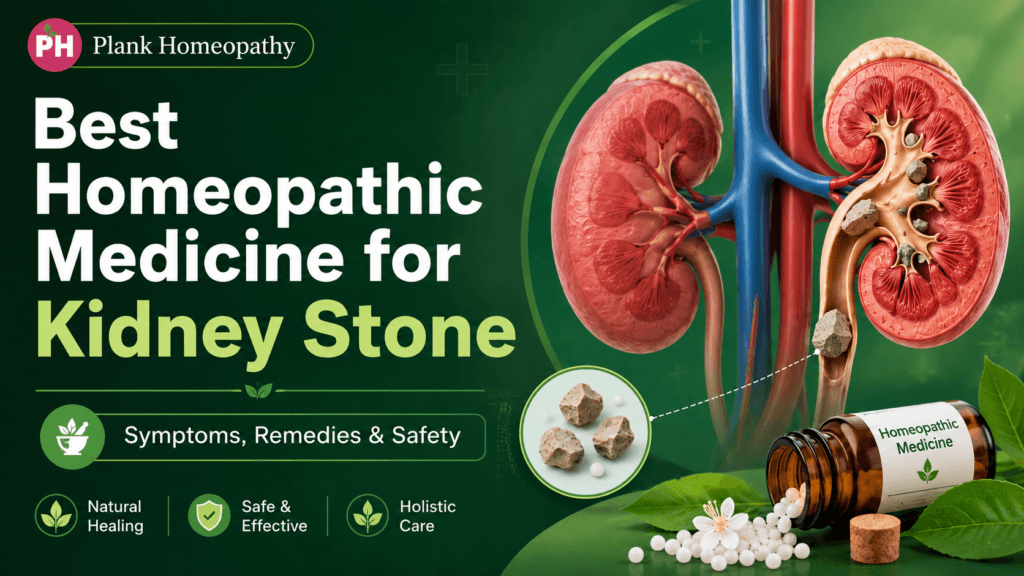
Best Homeopathic Medicine for Kidney Stone


Kidney stones are hard mineral deposits that form inside the kidneys or urinary tract. They can be tiny like sand particles or larger stones that may block urine flow and cause severe pain. Many people search for homeopathic medicine for kidney stone because they want a gentle, individualized, and supportive approach for kidney stone symptoms, pain, recurrence, or urinary discomfort.
Homeopathy may be considered as supportive care for kidney stone-related complaints, especially when the remedy is selected according to the patient’s exact symptoms, pain pattern, urine changes, side of pain, and overall constitution. However, kidney stones can sometimes become a medical emergency. Severe pain, fever, vomiting, blood in urine, or difficulty passing urine should never be ignored.
This article explains kidney stones, symptoms, causes, commonly used homeopathic remedies for kidney stones, safety precautions, diet support, and when medical care is necessary.
What Are Kidney Stones?
Kidney stones are solid deposits made from minerals and salts in the urine. In medical terms, kidney stones may also be called renal calculi, nephrolithiasis, or urolithiasis.
Normally, urine contains water, minerals, salts, and waste products. When urine becomes too concentrated, minerals can crystallize and slowly form stones. These stones may remain in the kidney or move down through the ureter, bladder, and urinary passage.
Small stones may pass naturally through urine, but larger stones can cause obstruction, infection, or severe pain.
Common Types of Kidney Stones
Different types of kidney stones can form depending on urine chemistry, diet, hydration, infection, and metabolic factors.
The common types include:
- Calcium oxalate stones: The most common type. These may be linked with low water intake, high oxalate foods, excess salt, or metabolic tendency.
- Uric acid stones: These may occur when urine is too acidic or when uric acid levels are high.
- Struvite stones: These are often associated with urinary tract infections.
- Cystine stones: These are less common and may be related to inherited metabolic conditions.
Knowing the stone type is important because prevention advice may differ. A person with calcium oxalate stones may need different dietary guidance than someone with uric acid stones.
Common Symptoms of Kidney Stones
Kidney stones do not always cause symptoms. Some small stones may remain silent and are found during ultrasound or imaging done for another reason. But when a stone moves or blocks urine flow, symptoms can become intense.
Common kidney stone symptoms include:
- Sharp pain in the side, back, or lower abdomen
- Pain moving from the flank to the groin
- Burning or pain during urination
- Frequent urge to urinate
- Blood in urine
- Cloudy or foul-smelling urine
- Nausea or vomiting
- Restlessness during pain
- Fever or chills if infection is present
- Difficulty passing urine in severe obstruction
Kidney stone pain is often called renal colic. It may come in waves and can be severe enough to require urgent medical care.
Kidney Stone Pain and Urinary Symptoms
Many people search for homeopathic medicine for kidney stone pain when they experience pain radiating from the back to the groin, burning urination, or difficulty passing urine. Homeopathy traditionally considers the exact nature of pain before selecting a remedy.
For example, a person may have cutting pain, burning pain, stitching pain, cramping pain, or pain that changes with movement. Some may feel better from warmth, pressure, bending double, or passing urine. These details matter in homeopathic remedy selection.
However, severe kidney stone pain should not be self-treated for long. If pain is unbearable, associated with fever, vomiting, or reduced urine output, medical evaluation is necessary.
What Causes Kidney Stones?
Kidney stones can form due to many reasons. Often, more than one factor is involved.
Common causes and risk factors include:
- Low water intake
- Dehydration
- High salt intake
- High intake of animal protein
- High oxalate diet in susceptible people
- High uric acid levels
- Recurrent urinary tract infections
- Family history of kidney stones
- Obesity
- Certain metabolic disorders
- Some medications or supplements
- Hot climate with excessive sweating
- Not passing urine frequently
Dehydration and Concentrated Urine
One of the biggest risk factors for kidney stones is low fluid intake. When the body does not receive enough water, urine becomes concentrated. This allows minerals and salts to crystallize more easily.
People living in hot climates, those who sweat more, or those who drink very little water may have a higher risk of stone formation.
Diet and Lifestyle Factors
A diet high in salt, processed foods, sugary drinks, and excessive animal protein may increase kidney stone risk in some people. Low intake of fluids, low intake of citrate-rich foods, and irregular eating habits may also contribute.
Diet should be personalized based on the stone type. For example, people with uric acid stones may need guidance on purine-rich foods, while people with calcium oxalate stones may need advice about oxalate balance, salt intake, and calcium timing.
Can Homeopathy Help Kidney Stones?
Many people look for homeopathic treatment for kidney stones because they want a natural and individualized approach. Homeopathy does not treat only the stone size or location. It considers the person’s total symptom picture.
A homeopathic doctor may evaluate:
- Location of pain
- Side affected: right, left, or both
- Direction of pain radiation
- Burning during urination
- Urine color and odor
- Frequency of urination
- Presence of gravel or sediment
- Past history of stones
- Tendency to recurrence
- Food habits and thirst
- Associated acidity, digestion, or uric acid tendency
- Mental and physical constitution
Homeopathy may be considered as supportive care in selected cases, especially for symptom management and recurrence tendency. But it should not replace emergency treatment, diagnostic evaluation, or surgical care when medically required.
Is There One Best Homeopathic Medicine for Kidney Stone?
There is no single best homeopathic medicine for kidney stones that works for everyone. The best remedy depends on the individual case.
Two people may both have kidney stones, but one may have right-sided pain with red sand-like urine, while another may have left-sided pain radiating to the bladder with burning urination. Their homeopathic remedies may differ.
This is why remedy selection, potency, dosage, and repetition should be guided by a qualified homeopathic doctor.
Best Homeopathic Medicines for Kidney Stones Traditionally Used
Several remedies are traditionally used in homeopathy for kidney stone-related symptoms. These remedies should not be taken as guaranteed cures or fixed prescriptions. They are mentioned for educational understanding.
Berberis Vulgaris for Kidney Stone Pain Radiating to the Groin
Berberis Vulgaris is one of the most commonly discussed homeopathic remedies for kidney stone complaints. It is traditionally considered when pain starts in the kidney region and radiates toward the bladder, ureter, or groin.
It may be considered when symptoms include:
- Pain in the kidney area
- Pain radiating to the groin or thighs
- Stitching, cutting, or shooting pain
- Urinary discomfort
- Pain that changes location
- Sensation of soreness in the kidney region
Many people search for Berberis Vulgaris homeopathic medicine for kidney stone, especially when there is flank pain with radiation. However, the remedy should be selected only after proper case evaluation.
Sarsaparilla for Painful Urination and Stone-Related Urinary Symptoms
Sarsaparilla is traditionally used in homeopathy when urinary symptoms are prominent. It may be considered when there is pain at the end of urination or difficulty passing urine.
It may be associated with:
- Painful urination
- Burning after urination
- Gravel-like urine complaints
- Urine discomfort with stone tendency
- Pain while passing the last drops of urine
Sarsaparilla is often discussed as a homeopathic remedy for kidney stones when urinary pain is more noticeable than back pain.
Hydrangea for Gravel-Like Urinary Complaints
Hydrangea is traditionally known in homeopathy for gravel-like urinary complaints. It may be considered when there is sediment, sandy particles, or stone-forming tendency.
🌿 Get Expert Homeopathic Care
Consult our experienced homeopathic doctors for personalised treatment
It may be considered in cases with:
- Gravel in urine
- Frequent urination
- Urinary discomfort
- Stone tendency with sediment
- Pain in the kidney area
Some people search for Hydrangea homeopathic medicine for kidney stones or homeopathic drops for kidney stones because Hydrangea is often available in mother tincture form. Still, mother tinctures should not be used without professional guidance, especially in people with kidney disease or other medical conditions.
Cantharis for Burning Urination
Cantharis is traditionally used when burning urination is intense. It may be considered when a person feels constant urge to urinate, but only a small quantity of urine passes with burning or cutting pain.
Possible symptom patterns include:
- Severe burning during urination
- Frequent urge to pass urine
- Pain before, during, or after urination
- Irritation in the urinary tract
- Restlessness due to urinary discomfort
Cantharis may be considered when stone-related urinary irritation resembles burning cystitis-like symptoms. But if fever, infection, or blood in urine is present, medical care is important.
Lycopodium for Right-Sided Kidney Stone Complaints
Lycopodium is traditionally considered in homeopathy for right-sided complaints and digestive associations. In kidney stone cases, it may be considered when symptoms are more right-sided or associated with gas, bloating, or uric acid tendency.
It may be considered when there is:
- Right-sided kidney pain
- Pain before urination
- Red or sandy sediment in urine
- Digestive bloating with urinary complaints
- Recurring stone tendency
Many people search for Lycopodium homeopathic medicine for kidney stones, especially for right-sided kidney complaints. But Lycopodium is a deep-acting constitutional remedy and should be used carefully under professional supervision.
Ocimum Canum, Pareira Brava, Benzoic Acid and Nux Vomica
Other remedies may also be considered depending on the exact symptom pattern.
Ocimum Canum
Ocimum Canum is traditionally considered in renal colic and uric acid-related urinary complaints. It may be thought of when there is severe kidney pain with urine changes.
Pareira Brava
Pareira Brava may be considered when a person has severe straining during urination and feels difficulty passing urine. It is traditionally associated with painful urinary complaints.
Benzoic Acid
Benzoic Acid may be considered when urine has a strong odor or when uric acid tendency is prominent. It may be relevant in some uric acid stone tendencies.
Nux Vomica
Nux Vomica may be considered when kidney stone complaints occur in people with sedentary habits, digestive issues, acidity, constipation, irritability, or excess stimulants. It is not a direct “stone-removal” medicine but may be considered based on the whole symptom picture.
Homeopathic Medicine for Kidney Stone Pain
Kidney stone pain can be very severe. Homeopathy may be considered as supportive care in mild or recurring urinary complaints, but acute renal colic needs careful attention.
A qualified homeopathic doctor may choose a remedy based on:
- Type of pain: cutting, stitching, burning, cramping
- Location: left kidney, right kidney, bladder, ureter
- Radiation: groin, thigh, lower abdomen
- Urine changes: blood, burning, sediment, frequency
- Modalities: better or worse from movement, pressure, warmth, cold, urination
- Associated symptoms: nausea, vomiting, fever, chills
When Pain Needs Urgent Medical Care
Do not rely only on home remedies or self-medication if kidney stone pain is severe. Seek urgent medical care if there is:
- Unbearable pain
- Fever or chills
- Vomiting
- Blood in urine
- Difficulty passing urine
- Reduced urine output
- Pain with pregnancy
- Known kidney disease
- Single functioning kidney
- Diabetes with urinary symptoms
- Recurrent stones with worsening pain
These symptoms may suggest obstruction, infection, or complications.
Can Homeopathic Medicine Dissolve or Pass Kidney Stones?
Many people search for homeopathic remedy for dissolving kidney stones or homeopathic medicine for dissolving kidney stones. This should be understood carefully.
Small stones may pass naturally in some cases with adequate hydration and medical guidance. Some urinary symptoms may improve with supportive care. But no one should assume that a medicine can always dissolve or remove stones.
Whether a stone can pass depends on:
- Stone size
- Stone location
- Stone type
- Degree of obstruction
- Presence of infection
- Kidney function
- Patient’s overall health
Large stones, obstructing stones, infected stones, or stones causing kidney swelling need proper medical attention. In some cases, procedures such as lithotripsy, ureteroscopy, laser treatment, or surgery may be required.
Homeopathy may be considered as supportive and individualized care, but it should not delay urgent treatment.
Homeopathic Drops, Mother Tinctures, Cell Salts and Potencies for Kidney Stones
People often search for homeopathic drops for kidney stones, homeopathic mother tinctures for kidney stones, homeopathic cell salts for kidney stones, or German homeopathic medicine for kidney stone.
These terms are common, especially among people looking for ready-made homeopathic products. But kidney stone treatment should not be based only on product names or brand claims.
What Q, 6X, 30C and 200C Mean
In homeopathy:
- Q usually means mother tincture.
- 6X is a low potency often used in biochemic or tissue salt preparations.
- 30C is a commonly used potency in homeopathic practice.
- 200C is a higher potency and should be used with more caution.
- 1M and above are high potencies and should be used only under expert guidance.
Higher potency does not mean “stronger” in the ordinary medicine sense. The right potency depends on the person, symptoms, sensitivity, and case depth.
Why Dosage Should Be Doctor-Guided
Self-medicating repeatedly with homeopathic medicines may confuse the case or aggravate symptoms in sensitive individuals. A qualified homeopathic doctor can decide:
- Which remedy is suitable
- Which potency is appropriate
- How often it should be repeated
- When to stop
- When medical referral is necessary
This is especially important for kidney stone patients because complications can occur if obstruction or infection is missed.
Conventional Diagnosis and Medical Treatment You Should Know
Even if you want homeopathic support, diagnosis is important. Kidney stone symptoms can resemble urinary tract infection, appendicitis, gallbladder pain, back pain, or other medical conditions.
A doctor may suggest:
- Ultrasound KUB
- CT scan
- Urine routine test
- Urine culture
- Kidney function test
- Blood calcium
- Uric acid level
- Stone analysis after passage
- Imaging to check obstruction or swelling
When Medical Procedures May Be Needed
Some kidney stones may not pass naturally and may need medical intervention. Procedures may be needed if:
- The stone is large
- Pain is uncontrolled
- There is infection
- The kidney is swollen
- Urine flow is blocked
- Kidney function is affected
- The stone is recurrent or complicated
Homeopathy should not be used to delay emergency care in such cases.
Diet, Water and Lifestyle Support for Kidney Stone Prevention
Prevention is very important because kidney stones can recur. Lifestyle changes can reduce the risk in many people.
Drink Enough Water
Adequate hydration helps dilute urine and reduce crystal formation. The goal is usually to produce pale urine through the day, unless a doctor has restricted fluids due to kidney, heart, or other conditions.
People who sweat heavily or live in hot weather may need more fluids.
Reduce Excess Salt
High salt intake can increase calcium in urine and may raise stone risk. Reducing packaged foods, salty snacks, processed meats, and excess table salt can help.
Do Not Stop Calcium Without Advice
Many people think calcium stones mean they should stop calcium completely. This is not always correct. Very low dietary calcium may actually increase oxalate absorption in some people.
Calcium intake should be balanced and guided by a healthcare provider.
Limit Excess Animal Protein
Too much animal protein may increase uric acid and reduce citrate in urine in some people. Moderation may help, especially in people with uric acid stones or recurrent stones.
Be Careful With High-Oxalate Foods
People with calcium oxalate stones may need individualized advice on foods such as spinach, beetroot, nuts, chocolate, tea, and certain seeds. These foods are not bad for everyone, but stone-prone individuals may need moderation.
Citrate-Rich Foods
Lemon or citrus intake may support urinary citrate levels in some people. However, people with acidity, reflux, kidney disease, or dietary restrictions should take personalized advice.
Home Remedies vs Homeopathic Remedies for Kidney Stones
Many people confuse home remedies and homeopathic remedies. They are different.
Home remedies may include water intake, lemon water, diet changes, or lifestyle measures. These may support prevention and urinary health, but they are not a substitute for diagnosis.
Homeopathic remedies are selected according to symptoms and constitution. For example, Berberis Vulgaris, Sarsaparilla, Hydrangea, Cantharis, and Lycopodium may be considered in different symptom patterns.
A balanced plan may include:
- Proper diagnosis
- Medical monitoring
- Pain and emergency care when needed
- Diet and hydration guidance
- Individualized homeopathic support
- Prevention strategy based on stone type
Side Effects and Precautions of Homeopathic Medicine for Kidney Stone
Homeopathic medicines are generally considered gentle when used correctly, but they should still be taken responsibly. The main risk is not always from the remedy itself, but from delaying proper medical care.
Possible concerns include:
- Repeated self-medication without diagnosis
- Using high potencies too frequently
- Ignoring severe pain or infection
- Delaying treatment for obstruction
- Taking mother tinctures without guidance
- Using alcohol-based drops in sensitive individuals
- Overlapping multiple remedies without supervision
Who Should Avoid Self-Medication?
Self-medication should be avoided in:
- Pregnant women
- Children
- Elderly patients
- People with chronic kidney disease
- People with one kidney
- Diabetic patients with urinary symptoms
- Patients with fever or chills
- Patients with blood in urine
- Patients with severe vomiting
- Patients with reduced urine output
- Patients with recurrent or large stones
In such cases, professional medical evaluation is important.
Red-Flag Symptoms That Need Immediate Medical Attention
Kidney stones can sometimes lead to serious complications. Seek urgent medical care if you notice:
- Severe pain that does not improve
- Fever or chills
- Nausea and repeated vomiting
- Blood in urine
- Burning urination with fever
- Inability to pass urine
- Reduced urine output
- Pain in pregnancy
- Confusion or weakness
- Known kidney disease with stone pain
These symptoms may indicate infection, obstruction, or kidney stress.
Final Takeaway
Homeopathic medicine for kidney stone may be considered as supportive and individualized care, especially when symptoms such as kidney pain, urinary burning, gravel-like urine, or recurrence tendency are present. Commonly discussed homeopathic remedies for kidney stones include Berberis Vulgaris, Sarsaparilla, Hydrangea, Cantharis, Lycopodium, Ocimum Canum, Pareira Brava, Benzoic Acid, and Nux Vomica.
However, there is no single best homeopathic medicine for every kidney stone case. Remedy selection depends on the person’s exact symptoms, stone tendency, pain pattern, urine changes, and overall constitution.
Kidney stones should be handled carefully. Small stones may pass naturally in some cases, but large, obstructing, infected, or painful stones may need urgent medical care. Homeopathy should not replace diagnosis, emergency care, or necessary medical procedures.
For safe results, consult a qualified healthcare provider for proper diagnosis and a qualified homeopathic doctor for individualized remedy selection, potency, dosage, and follow-up.
- Morice AH, Millqvist E, Bieksiene K, et al. ERS guidelines on the diagnosis and treatment of chronic cough in adults and children. European Respiratory Journal. 2020. (PubMed)
- National Institute of Diabetes and Digestive and Kidney Diseases (NIDDK). Kidney Stones. (NIH)
- MedlinePlus. Kidney Stones. (MedlinePlus)
- Mayo Clinic. Kidney stones - Symptoms and causes. (Mayo Clinic)
- NHS. Kidney stones. (Nhs)

Plank Homeopathy is a Bangalore-based online homeopathic clinic founded in 2018. We connect patients across India with qualified BHMS doctors for personalised consultations, doctor-curated medicine kits, and free treatment plans. Every article on this platform is written and reviewed by registered homeopathic physicians to ensure accurate, trustworthy health information.