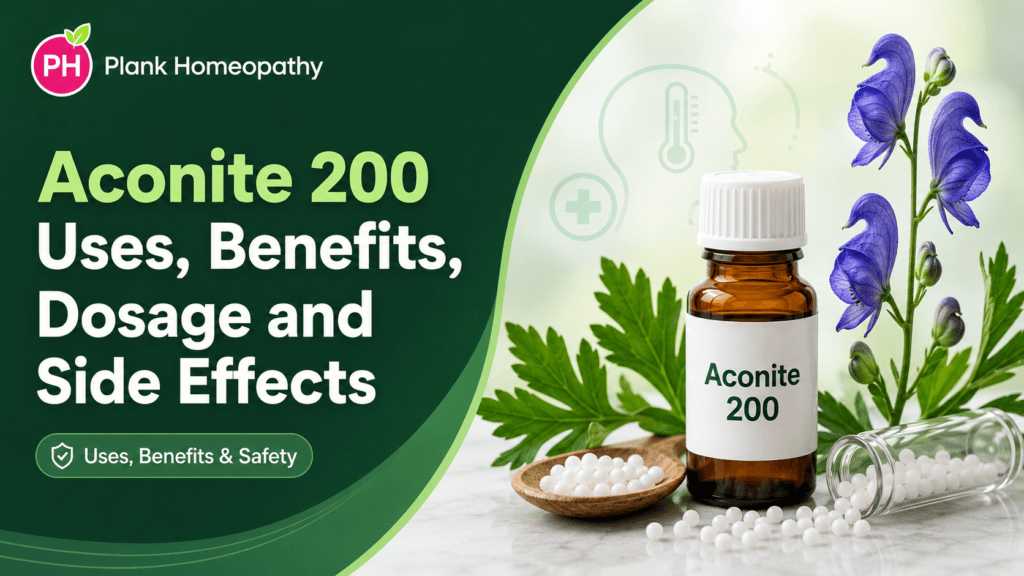
Aconite 200 Uses, Benefits, Dosage and Side Effects


Aconite 200 is a commonly discussed homeopathic remedy prepared from Aconitum napellus, a plant also known as monkshood or wolfsbane. In homeopathy, Aconite 200C or Aconite 200 CH is traditionally used for sudden-onset complaints, especially when symptoms appear quickly after exposure to cold dry wind, fright, shock, anxiety, or sudden fever-like states.
Many people search for aconite 200 uses, aconite 200 dosage, aconite 200 side effects, and whether aconite homeopathic medicine is safe. The most important point is this: homeopathic Aconite 200 is very different from crude aconite plant material. The raw aconite plant contains toxic alkaloids and should never be consumed or handled casually. Homeopathic dilutions are prepared differently, but they should still be used responsibly and preferably under the guidance of a qualified homeopathic doctor.
This article explains Aconite 200 uses, benefits, dosage guidance, side effects, precautions, and safety in a clear and balanced way.
What Is Aconite 200?
Aconite 200 is a homeopathic dilution made from Aconitum napellus. It is usually written as Aconite 200, Aconite 200C, Aconite 200 CH, Aconitum napellus 200, or Aconitum napellus 200C.
In homeopathy, remedies are selected based on the overall symptom picture, not only the disease name. Aconite 200 is traditionally associated with sudden, intense, early-stage symptoms that appear rapidly. The person may feel restless, fearful, anxious, or unusually sensitive along with physical symptoms.
Aconite 200 is available in different forms, such as:
- Liquid dilution
- Globules or pellets
- Tablets
- Medicated sugar pills
In India, people may search for terms like Aconite dilution 200 CH, Aconitum napellus dilution 200 CH, SBL Aconite 200, Dr Reckeweg Aconite 200, ADEL Aconite 200, or Similia Aconite 200 CH dilution. These are usually product-search variations, but the core remedy name remains Aconitum napellus.
Aconite, Aconitum Napellus, Monkshood and Homeopathic Dilution Explained
Aconitum napellus is the botanical name of the plant. Monkshood and wolfsbane are common names. The crude plant is known to be poisonous and is not the same as a homeopathic dilution.
This distinction matters because online information about “aconite” may refer to different things:
- Crude aconite plant or extract
- Herbal aconite preparations
- Aconitine toxicity
- Homeopathic Aconite 200C or 200 CH
For safety, never use crude aconite root, plant material, homemade extracts, or unverified aconite supplements. Aconite homeopathic medicine should be purchased from reliable sources and used according to professional advice.
Aconite 200 Uses in Homeopathy
Aconite 200 uses in homeopathy are traditionally linked with acute complaints that begin suddenly and strongly. It is often considered in the early stage of symptoms, especially when the person feels restless, anxious, fearful, or shocked.
Common traditional uses include:
- Sudden fever-like symptoms
- Cold symptoms after exposure to cold dry wind
- Early sore throat or throat irritation
- Sudden headache
- Restlessness with anxiety
- Panic-like fear or shock
- Sudden chill or heat sensation
- Early inflammatory complaints
- Dry cough or chest tightness in early stages
- Symptoms after fright, shock, or sudden fear
These uses are based on homeopathic tradition and remedy pictures. They should not be understood as guaranteed results or as a replacement for medical diagnosis.
Sudden Fever, Cold Symptoms, Restlessness and Acute Complaints
Aconite 200 is often discussed for symptoms that come on suddenly. For example, a person may feel well during the day but develop sudden feverishness, chills, headache, dry throat, or restlessness after exposure to cold wind.
The classic homeopathic picture may include:
- Sudden onset
- Intense symptoms
- Anxiety or fear
- Restlessness
- Dryness of throat or skin
- Sensitivity to cold dry air
- Feeling worse at night
- Strong thirst in some cases
However, fever can be caused by viral infections, bacterial infections, inflammatory illness, dehydration, or other serious conditions. Aconite 200 may be considered as supportive homeopathic care only when appropriate, but high fever, persistent fever, breathing difficulty, chest pain, confusion, dehydration, severe weakness, or worsening symptoms require medical care.
Aconite 200 Benefits: What It May Support
Aconite 200 benefits are best understood from a homeopathic perspective. It is not used like a conventional painkiller, antibiotic, fever reducer, or sedative. Instead, it is selected when the person’s total symptom pattern matches the remedy picture.
Traditionally, Aconite 200 may support:
- Early-stage sudden complaints
- Calmness during acute fear or shock-like states
- Relief of restlessness linked with sudden illness
- Comfort during sudden cold or fever-like symptoms
- Support in early throat or respiratory irritation
- Homeopathic management of acute sensitivity after cold exposure
The benefit depends on correct remedy selection. If the symptom picture does not match Aconite, another remedy or medical treatment may be more suitable.
Traditional Homeopathic Perspective on Aconite 200C and Aconite 200 CH
Aconite 200C and Aconite 200 CH generally refer to the same potency scale used in homeopathy. The “200” indicates the potency level, while “C” or “CH” refers to centesimal dilution.
In homeopathic practice, higher potencies such as 200C are often used more carefully than lower potencies. Aconite 200 is usually not meant for frequent, casual repetition without guidance. The decision depends on:
- Nature of symptoms
- Intensity of symptoms
- Duration of illness
- Patient’s age and sensitivity
- Past medical history
- Response after the first dose
- Whether symptoms are improving, changing, or worsening
A qualified homeopathic doctor can decide whether Aconite 200C, Aconite 30, or another remedy is more appropriate.
Aconite 200 Dosage and How to Take It Safely
Aconite 200 dosage should be individualized. There is no single universal dose that is right for everyone. Homeopathic dosage depends on the person, potency, symptoms, sensitivity, and clinical situation.
General safe-use principles include:
- Use only from a trusted homeopathic manufacturer.
- Avoid repeated dosing without professional guidance.
- Stop repeating once symptoms improve.
- Do not use it as a substitute for urgent medical care.
- Avoid self-medicating infants, pregnant women, elderly patients, or people with serious health conditions.
- Consult a qualified homeopathic doctor for correct potency and repetition.
Some people take homeopathic dilutions as drops in water, while others use globules or pellets. Follow the label instructions and your doctor’s advice. Do not increase dose frequency because symptoms feel intense. In homeopathy, more frequent repetition is not always better.
🌿 Get Expert Homeopathic Care
Consult our experienced homeopathic doctors for personalised treatment
Why Potency, Repetition and Remedy Selection Should Be Individualized
Aconite 200 is a higher potency than Aconite 30. In homeopathy, higher potency remedies are often selected when symptoms are clear, intense, and strongly match the remedy picture. But they may not be suitable for everyone.
The three key factors are:
- Remedy selection: Does the person’s symptom picture match Aconite?
- Potency: Is 200C appropriate, or would a lower potency be safer?
- Repetition: Should it be repeated, paused, or changed?
If symptoms improve after taking Aconite 200, unnecessary repetition should usually be avoided. If symptoms do not improve or become worse, medical evaluation is important.
Aconite 200 Side Effects, Precautions and Safety
Aconite 200 side effects are uncommon when a properly prepared homeopathic dilution is used correctly, but safety still matters. Some people may experience temporary changes in symptoms, sensitivity, or aggravation-like responses. Any unusual, severe, or worsening reaction should be taken seriously.
Possible concerns include:
- Worsening of existing symptoms
- New discomfort after use
- Allergic-type reaction to inactive ingredients
- Delay in proper medical treatment if symptoms are serious
- Unsafe use of crude aconite products mistaken for homeopathic medicine
The biggest safety concern is confusion between homeopathic Aconite and crude aconite plant preparations. Crude aconite, monkshood, wolfsbane, aconite root, and aconitine-containing products can be dangerous.
Difference Between Homeopathic Aconite and Toxic Crude Aconite Plant
Homeopathic Aconite 200C is a highly diluted preparation. Crude aconite plant material is different and may be toxic.
Do not use:
- Raw aconite root
- Aconite plant parts
- Homemade aconite extracts
- Unregulated aconite supplements
- Products not clearly labeled as homeopathic dilution
- Any aconite product recommended for internal use without proper safety guidance
Aconite plant exposure or ingestion can affect the nervous system and heart. Symptoms such as numbness, tingling, vomiting, dizziness, weakness, irregular heartbeat, chest discomfort, breathing difficulty, or collapse require urgent medical attention.
Who Should Avoid Aconite 200 or Use It Only With Medical Guidance?
Some people should avoid self-medicating with Aconite 200 and use it only after professional consultation.
Use extra caution in:
- Pregnant women
- Breastfeeding mothers
- Infants and young children
- Elderly patients
- People with heart disease
- People with serious respiratory illness
- People with neurological symptoms
- People taking multiple medications
- People with severe anxiety, panic attacks, or psychiatric conditions
- Anyone with persistent or worsening fever
Aconite 200 may be part of homeopathic care, but it should not delay diagnosis or emergency treatment.
Pregnancy, Breastfeeding, Children, Heart Conditions and Emergency Symptoms
Pregnancy and breastfeeding require special care. Even when a homeopathic remedy is highly diluted, self-medication is not ideal during pregnancy or while nursing. A qualified doctor should guide remedy selection.
Children also need careful evaluation. Fever, breathing difficulty, dehydration, lethargy, repeated vomiting, rash, or unusual crying in children should not be managed only with home remedies.
People with heart conditions should be especially cautious because crude aconite toxicity can affect heart rhythm. Even though homeopathic Aconite 200 is different, any chest pain, palpitations, fainting, severe weakness, or breathing difficulty needs urgent medical care.
Aconite 200 vs Aconite 30: What Is the Difference?
Aconite 30 and Aconite 200 are different potencies of the same remedy. Both are used in homeopathy, but they are not automatically interchangeable.
Aconite 30 is often considered a lower potency compared with Aconite 200. Aconite 200 is a higher potency and may be chosen when the symptom picture is strong and clear. The choice depends on the patient and the case.
Aconite 200 may not be the best choice for repeated casual use. If someone is unsure, it is better to ask a qualified homeopathic doctor instead of guessing between potencies.
Understanding 200C, 200 CH and Potency Strength in Simple Terms
In homeopathy, “200C” or “200 CH” refers to the centesimal potency scale. The remedy undergoes repeated dilution and succussion steps during preparation.
For readers, the practical point is simple:
- Aconite 200, Aconite 200C, and Aconite 200 CH usually refer to the same potency idea.
- Aconitum napellus 200C is the botanical/remedy name version.
- Aconite dilution 200 CH is a common product label wording.
- Higher potency does not mean it should be taken more often.
- Potency selection should be individualized.
Aconite 200 for Sudden Fever and Cold Symptoms
Aconite 200 is traditionally considered when fever or cold symptoms appear suddenly, especially after exposure to cold dry wind. The person may feel anxious, restless, thirsty, hot, chilled, or unable to settle.
It may be considered in a homeopathic setting when symptoms are at an early stage and the overall picture matches Aconite. However, fever is a body signal, not a disease by itself. It can occur due to infections and other medical causes.
Seek medical care if fever is:
- Very high
- Lasting more than a short period
- Associated with breathing difficulty
- Associated with rash, stiff neck, confusion, or severe headache
- Present in infants
- Associated with dehydration
- Worsening despite care
Aconite 200 should be used as supportive homeopathic care, not as a replacement for diagnosis.
Aconite 200 for Anxiety, Fear and Restlessness
Aconite homeopathy is also traditionally linked with sudden fear, shock, panic-like restlessness, and anxiety after a frightening experience. The person may feel intense worry, agitation, or a sense that something bad will happen.
Aconite 200 may be considered when emotional symptoms are sudden, intense, and connected with shock or fright. But ongoing anxiety, panic attacks, depression, trauma, insomnia, or mental health distress should be evaluated by a qualified healthcare professional.
Homeopathy may support emotional balance for some people, but it should not replace mental health care when symptoms are persistent, severe, or affecting daily life.
When to Consult a Doctor Instead of Self-Medicating
Self-medication has limits. Aconite 200 should not be used to manage serious or unclear symptoms without proper guidance.
Consult a qualified healthcare provider if you have:
- Persistent fever
- Severe headache
- Breathing difficulty
- Chest pain
- Palpitations
- Fainting
- Confusion
- Severe weakness
- Dehydration
- Repeated vomiting
- Severe throat pain
- Symptoms in infants or elderly patients
- Symptoms that keep worsening
- Any suspected poisoning or plant ingestion
For homeopathic care, consult a qualified homeopathic doctor who can assess the full case and decide whether Aconite 200 is suitable.
Warning Signs That Need Urgent Medical Care
Get urgent medical help if there is:
- Difficulty breathing
- Blue lips or severe breathlessness
- Chest pain or irregular heartbeat
- Loss of consciousness
- Severe allergic reaction
- Seizure
- Stiff neck with fever
- Severe dehydration
- Sudden weakness or numbness
- Suspected ingestion of crude aconite, monkshood, wolfsbane, or unknown plant material
These symptoms should not be treated only with homeopathic remedies.
Practical Safe-Use Tips for Aconite 200
If Aconite 200 has been recommended by a qualified practitioner, use it carefully.
Helpful tips include:
- Read the product label clearly.
- Confirm that it is a homeopathic dilution.
- Do not confuse it with herbal aconite extract.
- Avoid taking multiple remedies together unless advised.
- Do not repeat doses unnecessarily.
- Observe symptom changes after taking it.
- Stop and seek advice if symptoms worsen.
- Store away from children.
- Keep it away from heat, sunlight, and strong odors.
- Do not use expired or poorly labeled medicine.
Homeopathic remedies are usually selected with detail. The more accurate the case assessment, the better the chance of choosing the right remedy.
Final Thoughts
Aconite 200 is a well-known homeopathic remedy traditionally used for sudden-onset symptoms, especially those linked with acute fever-like states, cold exposure, restlessness, fear, shock, and early inflammatory complaints. It is also searched as Aconite 200C, Aconite 200 CH, Aconitum napellus 200C, and Aconite dilution 200 CH.
The most important safety point is to understand the difference between homeopathic Aconite 200 and crude aconite plant material. Crude aconite, monkshood, wolfsbane, and aconitine-containing substances can be toxic and should not be used casually.
Aconite 200 may be considered as part of individualized homeopathic care, but it should be used responsibly. Remedy selection, potency, dosage, and repetition should be guided by a qualified homeopathic doctor, especially for children, pregnant women, elderly patients, people with heart conditions, and anyone with severe or persistent symptoms.
This article is for educational purposes only and is not a substitute for professional medical advice, diagnosis, or treatment. Serious, persistent, worsening, painful, spreading, infected, bleeding, or emergency symptoms should always be evaluated by a qualified healthcare provider.
▶ Watch Related Video

Plank Homeopathy is a Bangalore-based online homeopathic clinic founded in 2018. We connect patients across India with qualified BHMS doctors for personalised consultations, doctor-curated medicine kits, and free treatment plans. Every article on this platform is written and reviewed by registered homeopathic physicians to ensure accurate, trustworthy health information.